Tega Collective: Digital ID for Post-Purchase Garment Ownership
Tega Collective is a small sustainable fashion brand creating Indo-Western clothing handcrafted by Adivasi communities in India. While the brand already shares artisan stories and sustainability education through social media and website content, these narratives are fragmented and often easily accessible only before purchase. Customers currently lack an interactive, post-purchase connection to the garment they own.
Challenge
Although Tega Collective shares artisan stories and sustainability narratives across its website and social platforms, this information remains disconnected from the physical garment. As a result, customers lack an ongoing way to engage with the garment they own, limiting long term connection and value beyond the point of purchase.
Solution
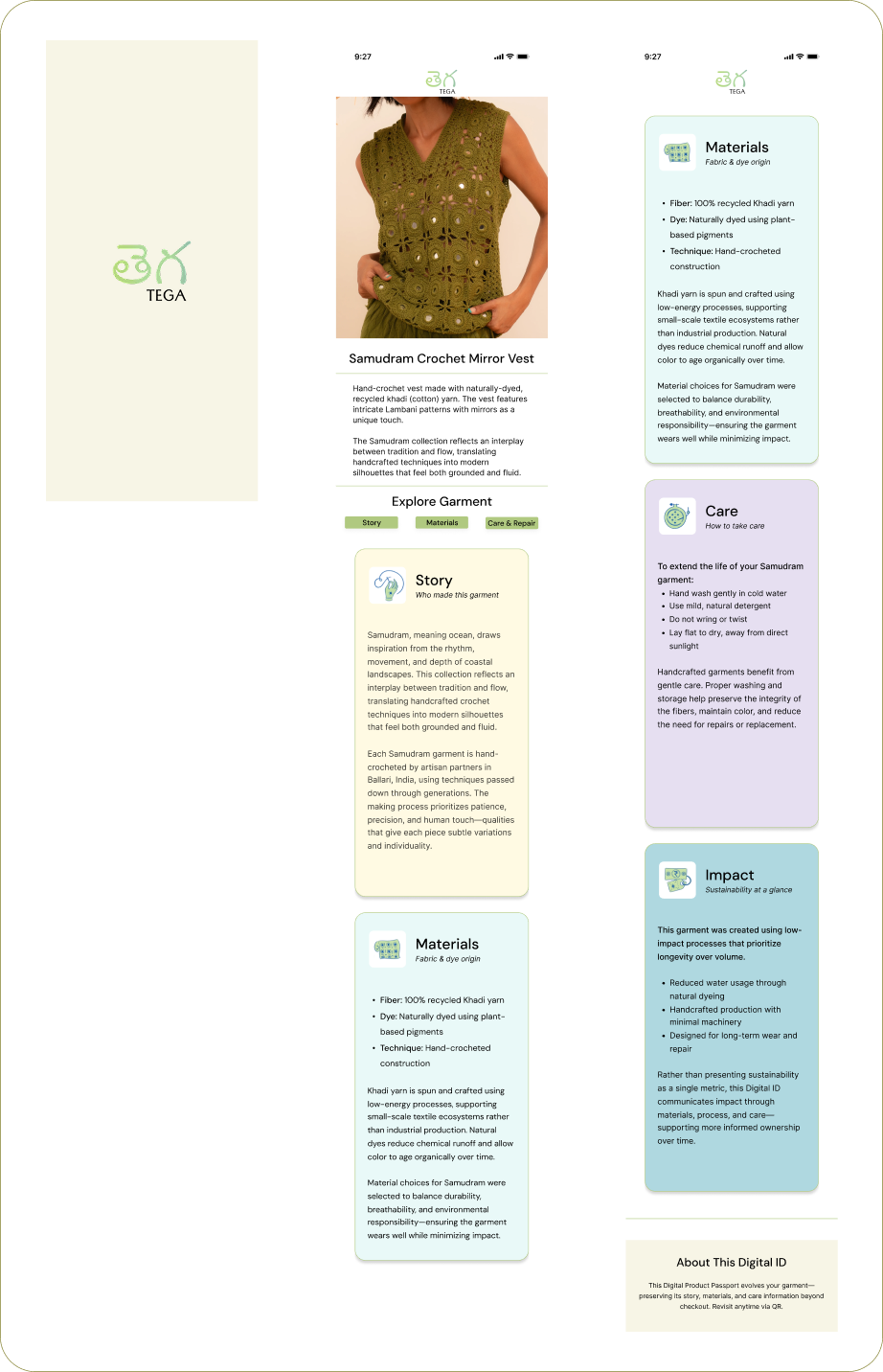
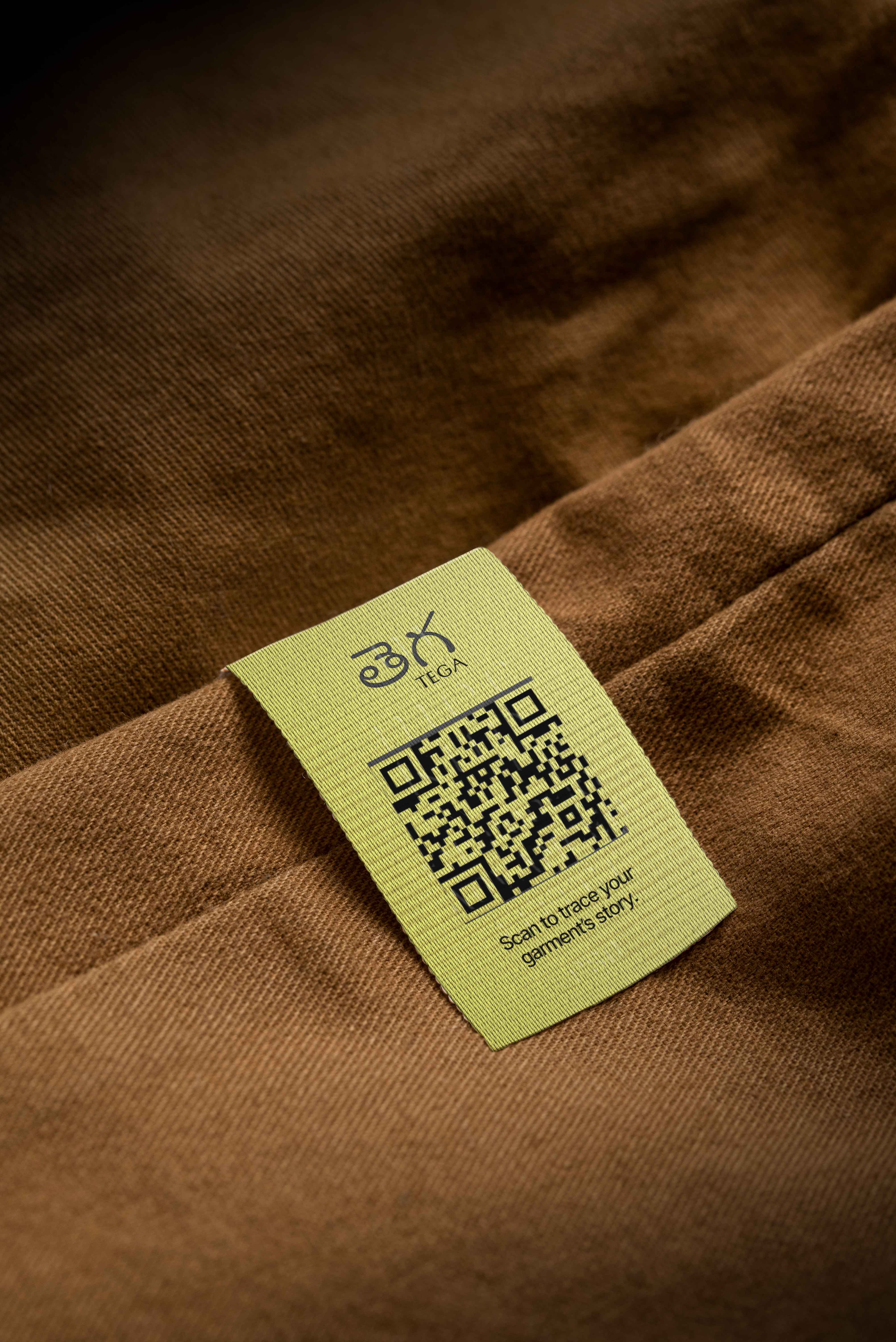
I designed a conceptual Digital Product Passport (DPP) in the form of a QR linked microsite that exists with the garments beyond purchase. Rather than replicating existing marketing content, the digital ID reframes storytelling as an ongoing relationship. It connects customers to explore the artisan story, sustainability impact, and garment care instructions, overall, creating a meaningful and interactive post purchase experience.
Role
UI/UX Designer
Tools
Figma, Photoshop
Deliverables
QR product tag design, Digital product passport microsite
Timeline
4 weeks
Introduction
Understanding Tega Collective as a small business Brand Context | Post Purchase Customer Perspective | Brand Constraints
The Brand Behind The Garment
Tega Collective produces small-batch, handmade garments with deep cultural and artisanal roots from Adivasi communities in India. While the brand does an incredible job at actively sharing artisan stories and sustainability efforts through social platforms and the brand website, the storytelling primarily exists at the point of discovery and doesn’t directly carry forward once a garment is purchased. This creates a post-purchase gap, a disconnect between the dedication and tradition handwoven in the clothing and the customer’s experience of owning it.
What Happens After Checkout?
Customers want an authentic connection with the product they purchase. Once a transaction is complete, product information isn’t always easily accessible or transparent in one single location. After purchase, customers may want to:
1. Revisit the story behind the garment, beyond social media marketing content
2. Understand who made their clothing and where materials came from
3. Access detailed and reliable care instructions for their garment
4. Feel confident that their purchase aligns with the brand’s sustainability values
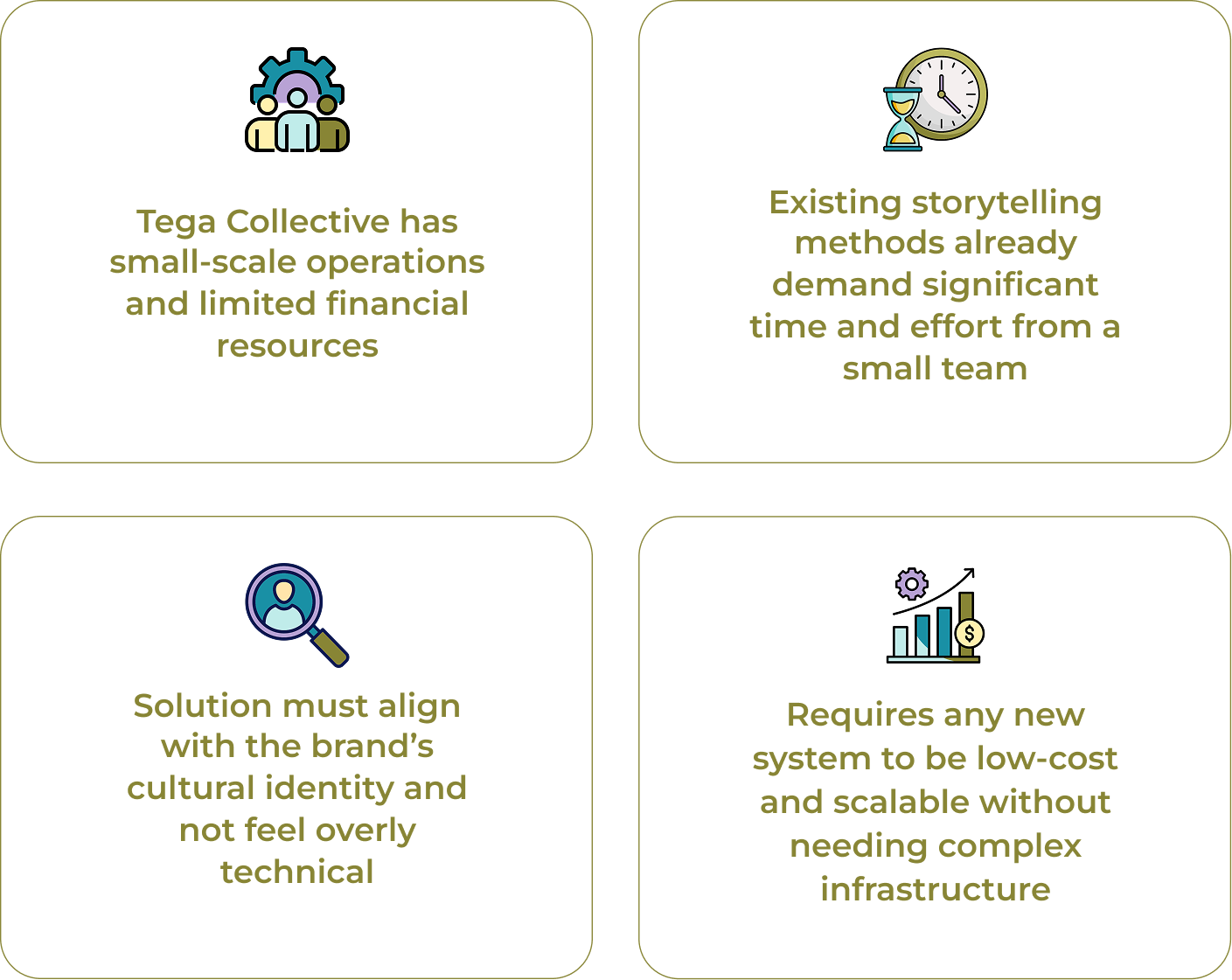
Constraints That Shape a Small Business
Empathize
Framing a Post-Purchase Digital Identity Desk Research | Competitive Analysis | User Interviews | Key Insights
Exploring Digital Product Passports
Digital Product Passports (DPPs) are being positioned as the next layer of infrastructure for product transparency in fashion, driven largely by upcoming regulation and the need for brands to maintain consistent, traceable product data over time. DPPs function as a form of digital identity for physical goods. In this project's context, a specific garment is linked to data about its origin, materials, and overall lifecycle. DPPs are intended to enable 'reduce, reuse, recycle', however, much of the current DPP talk circulates around data and compliance and not how users actually engage with the information after purchase. Most Digital ID implementations require enterprise-level infrastructure that small brands rarely have. While in many cases, even when DPPs are QR accessible, the experience functions as a static page rather than a post purchase journey that is user friendly enough to continue a relationship with the product.
This creates a gap: Small brands share compelling stories and values, but lack a scalable mechanism for a garment's digital identity to live with the product beyond the point of purchase. This project explores the core idea of a Digital Garment ID and how it can be translated into a lightweight, post-purchase system that preserves meaning and remains operationally sustainable for a small brand like Tega Collective.
Patterns Across Sustainable Fashion Brands
Using competitive analysis, I examined how sustainability-driven fashion brands approach sustainability storytelling and digital product experiences across the customer journey, specifically after purchase. While brands like Sheep Inc. offer access to garment information through a QR linked microsite, others primarily rely on pre-purchase website content or collection narratives that do not persist once a garment is owned. Most notably, I found that existing DPP approaches tend to prioritize either enterprise depth or aesthetics but rarely both in a way that is focused on the post-purchase user experience. This revealed a gap of opportunity for small brands like Tega Collective: the need for a garment-specific system that carries brand values forward without requiring complex or costly infrastructure.
User Interviews
To study real post-purchase behavior, I conducted five semi-structured interviews with consumers interested in sustainable fashion, including those familiar with Indo-Western brands. The interviews explored methods customers use to discover brand stories, what information they inquire about after purchase, and where pain points arise once a garment is owned.
I framed the interviews to explore broader questions around care and long-term engagement with clothing rather than testing a specific technical concept. Participants consistently described a disconnect between the brand values communicated before purchase and the information available after purchase. While many expressed interest in learning the stories of who made their clothes and how materials were sourced, this information is harder to access once a transaction was complete. Care instructions were frequently described as buried or easy to forget.
Several participants also emphasized the importance of convenience for post-purchase engagement. While transparency and sustainability is valued, participants were unwilling to download an additional app or navigate through complex steps to access product information.
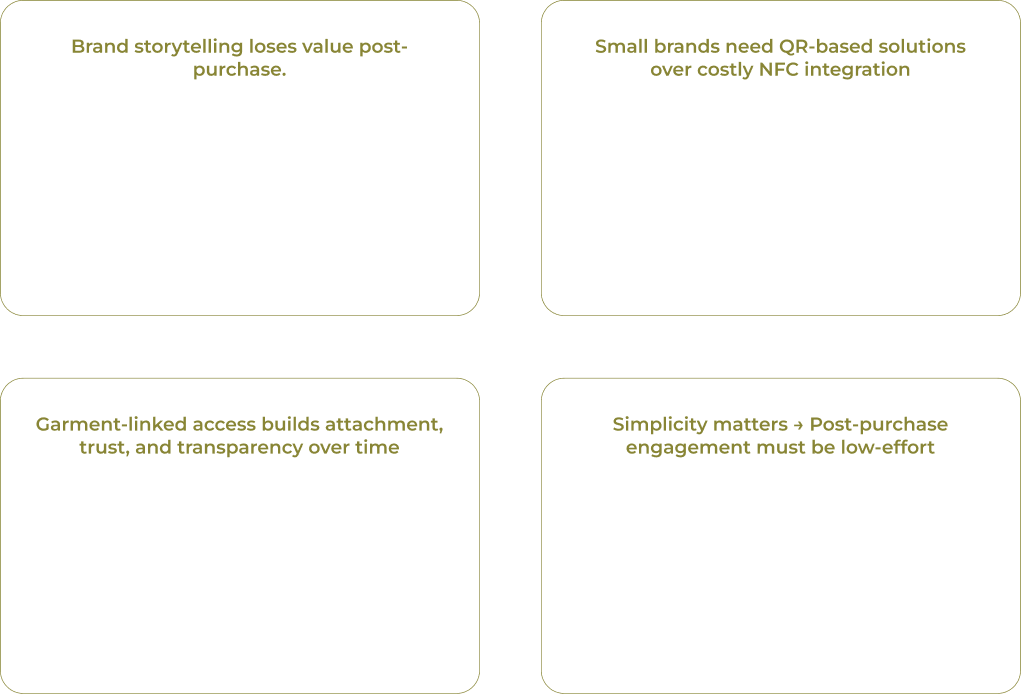
What The Research Made Clear
Define
From Insight to System Core Framing Question | Technical and Design Decisions | Post Purchase User Flow
The Question That Anchored the Work
Using the insights I gathered throughout my research methods, I defined the problem with one core framing question. This question intentionally reframed the problem away from marketing or discovery and towards ownership over time. The system needed to be a post-purchase experience, garment-specific, and feasible for a small brand to maintain.
Technical & Design Decisions
With the framing question established, I made several strategic decisions about how the system would function to balance user needs with small-brand constraints.
The Post-Purchase Journey
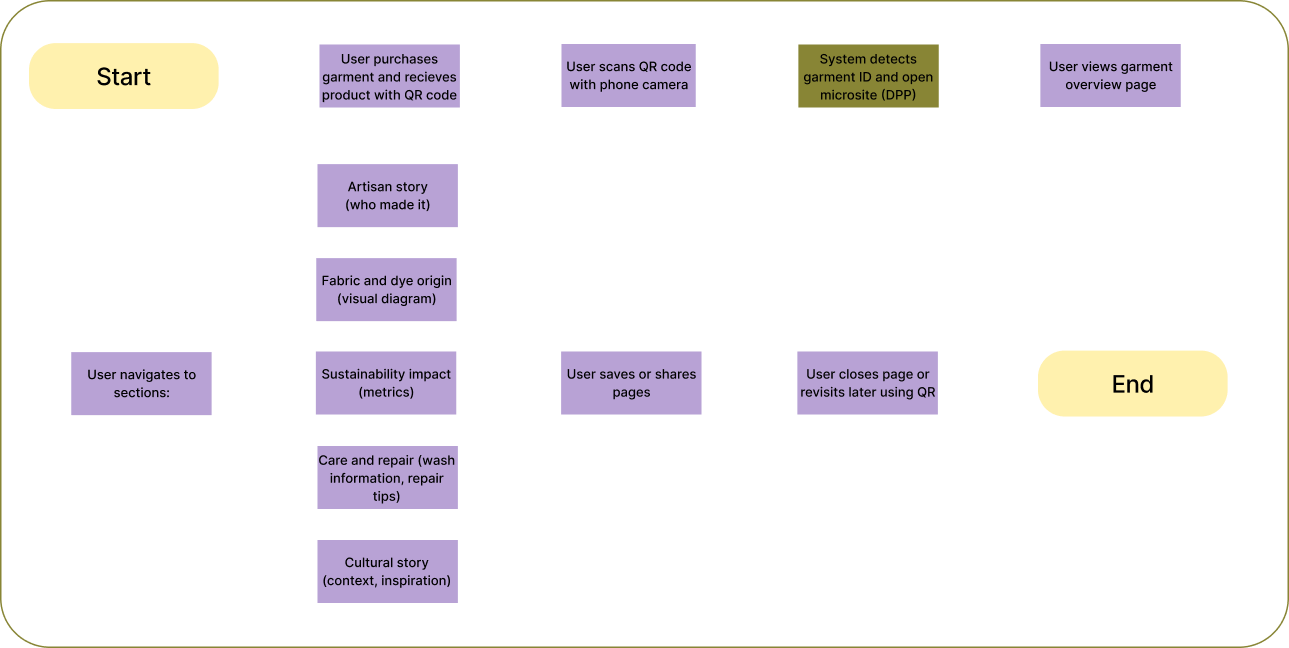
To translate the framing question into a concrete user experience, I mapped the post-purchase user flow for the DPP interaction. The flow begins once the customer purchases the garment and scans the QR code label attached to it. This action opens a garment-specific microsite that serves as the digital product passport. Customers can explore product information such as the artisanal story, material and dye origins, sustainability impact, and care or repair tips.
In addition to the customer experience, I considered how the system could scale sustainably for a small brand. The DPP was designed around a reusable content structure that could be applied across garments and collections. By using a consistent template, the brand can expand the system over time without redesigning the experience or introducing any technical complexity.
Most importantly, the flow supports repeat engagement. Allowing the same QR-linked experience to be accessed repeatedly shows that the system supports ongoing use across the garment’s lifecycle. This also reinforces the idea that transparency and care should continue with the garment beyond checkout.
Design
Shaping a Digital ID Experience Wireframes | Mockups
Laying the Foundation
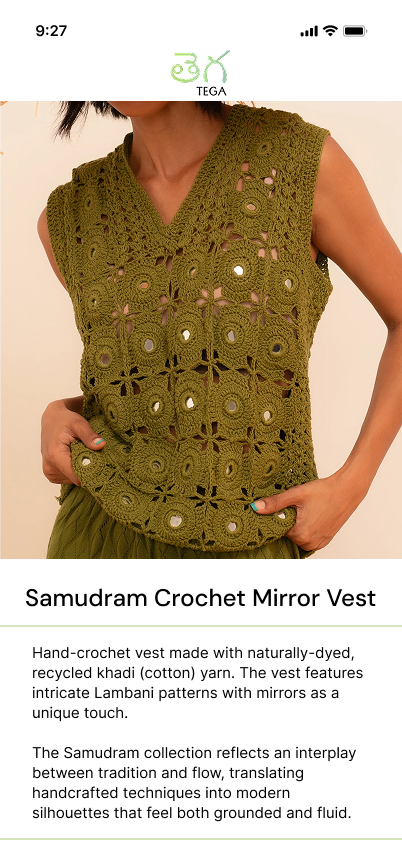
I focused the wireframes on defining a clear information hierarchy for a post-purchase Digital Product Passport. My goal was to separate orientation from exploration. First, by grounding users in the garment they own, then allowing them to intentionally navigate deeper into specific details.
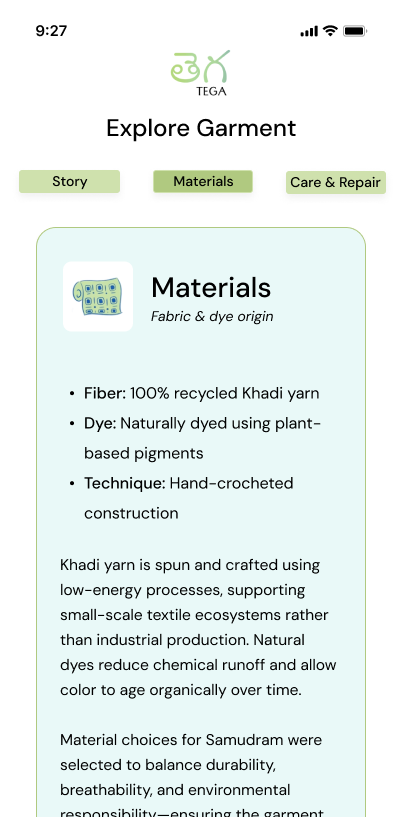
The landing state of the DPP prioritizes garment recognition through a strong visual and concise product description, ensuring users understand what the Digital ID refers to. Below this, an “Explore Garment” navigation establishes the primary interaction model, enabling users to navigate between Story, Materials, Care, and Impact by clicking each card button without overwhelming the screen.
Card-based layouts were used to compartmentalize content, allowing each section to function independently while remaining part of a cohesive system. This approach supported both scannability and revisit behavior.
Visualizing the Post-Purchase Experience
I translated the wireframes into high fidelity mockups to structure the templates into a visual language aligned with Tega Collective’s existing brand identity. Color, typography, and iconography were applied with restraint to maintain continuity with the brand while clearly differentiating functional sections within the Digital ID.
Soft color-coded cards help users distinguish between types of information. Subtle shadows, rounded corners, and generous spacing were used to create a calm, tactile reading experience appropriate for post-purchase engagement.
Interaction states and hierarchy were refined to emphasize clarity over novelty. Buttons were designed to remain persistent during scrolling, reinforcing section navigation, while card layouts support progressive disclosure of information. The final mockups balance emotional storytelling with practical utility, ensuring the Digital ID feels both meaningful and easy to use—reflecting the values of longevity, care, and transparency embedded in the garment itself.
Testing and Iteration
From Structure to Final Interaction Usability Testing | Key Findings and Redesign
Testing for Simplicity
To evaluate whether the DPP was intuitive and comprehendible in a real post-purchase context, I conducted informal usability testing with 5 participants unfamiliar with the project. The testing focused on first-time use after scanning a QR code, navigation between sections, and clarity of purpose.
Testing reinforced that even well-considered designs benefit from external perspectives, especially in post-purchase experiences where users are not actively shopping and expectations differ from traditional product pages. User task success improved from 80% to 100% after iterations.
What Success Would Look Like
If this system were implemented, I would measure success through several key metrics: QR code scan rates, return engagement, time spent on each section to understand which information resonates most, and reduction in customer service inquiries about care instructions. Qualitative feedback from both customers and Tega Collective about how the system affects their relationship with the garment would be equally important.
Limitations of Conceptual Work
Working conceptually meant making informed assumptions rather than measuring actual behavior. While user interviews provided valuable direction, real implementation would likely surface unexpected pain points—both in customer interaction and brand maintenance. Testing with prototype clicks differs significantly from observing how someone uses a system when washing a garment six months post-purchase, or how time-constrained a founder actually is when updating content during a busy production period.
Design Iterations
1. Clarifying the purpose of the Digital ID at entry
During usability testing, it was interpreted that the header was a continuation of the collection’s marketing page rather than a distinct post-purchase system. While the garment description was compelling, it obscured the function of the Digital Product Passport.
Iteration: The header copy was revised to explicitly frame the experience as a Digital ID that persists beyond checkout, while detailed collection storytelling was moved into the Story card. This clarified the system’s role without diminishing brand narrative.
2. Making interaction states visible and predictable
Iteration: During testing, users successfully navigated between sections but lacked confirmation when switching content. The absence of a clear active state caused uncertainty about whether an interaction had fully registered. Subtle click and active-state animations were added to the section buttons, improving interaction clarity without disrupting the visual tone of the brand.
Solution
Designing with users, not just for them Prototype | Solution Outcomes
A Click-Through Post-Purchase Experience
Garment Digital ID Mockup
Outcomes at the System Level
This project resulted in a lightweight Digital Product Passport system designed specifically for small, ethical fashion brands balancing transparency, storytelling, and long-term maintainability. Rather than treating transparency as static disclosure, the system reframes Digital ID as an ongoing relationship between the garment, the wearer, and the brand.
Established a post-purchase Digital ID experience that allows garment-specific information—story, materials, care, and impact—to persist beyond the point of sale.
Designed a modular, QR-linked microsite system that can scale across collections without requiring complex infrastructure or enterprise-level tooling.
Shifted sustainability communication from pre-purchase marketing content to post-purchase utility, supporting care, longevity, and informed ownership.
Created a repeatable content structure that enables brands to update or expand garment information over time without redesigning the experience.
Laid groundwork for future circular features such as repair history, resale, reuse while remaining feasible for a small business with limited technical resources.
Reflection
Lessons from Designing a Living System Reflection
Lessons from Designing a Small, Scalable System
This project reinforced that effective storytelling in digital systems is not about volume, but about continuity. While a lot of the research around Digital Product Passports emphasizes compliance, data standards, or traceability, designing this experience shifted my focus towards how information is actually encountered, remembered, and reused by people over time. The challenge wasn't deciding what information to include, but understanding when, how, and why someone would return to it after purchase.
Working within the constraints of a small, resource-limited brand required constant trade-offs between ambition and feasibility. Features that felt compelling in theory such as complex impact metrics were intentionally scaled back in favor of clarity and maintainability. This process sharpened my ability to recognize when design decisions add meaningful value versus when they introduce unnecessary complexity.
The project also deepened my understanding of systems design as a form of stewardship. Designing a Digital ID isn't just about creating an interface, it's also about shaping how responsibility, care, and ownership are communicated over time. By centering post-purchase moments like washing, repairing, or revisiting the story, the system reframes sustainability as an ongoing practice rather than a marketing claim.
The potential next steps toward implementation could involve creating one pilot DPP for Tega's next collection launch to test real-world usability, gathering actual customer feedback on content preferences and navigation, iterating based on Tega's content management experience, and developing a sustainable workflow that fits into their existing production timeline. This iterative approach would allow for validation and refinement before scaling across the full catalog.